
Most vision boards end the same way. A Sunday afternoon, a pile of magazines, a board that looks lovely, and then a corner of the room you stop seeing by March.
That is not a failure of willpower. It is what the research would predict about a board that stops at the pictures. The good news is that the same research says what to add so a board actually leads somewhere: goals that are truly yours, an honest look at what is in the way, and one small step with a time attached.
This guide walks through that, in seven steps, with a free printable template at the end.
Why most vision boards don't work
As far as we can find, no rigorous study has tested vision boards themselves. What has been studied, many times, is the thing a vision board is made of: picturing the future you want.
The psychologist Gabriele Oettingen spent years on it. In one set of studies, people looking for a job, students with a crush, students before an exam and patients after hip surgery were asked how they imagined things going. Those who expected good things, judging them likely, did better weeks or months later. Those who simply enjoyed vivid, positive daydreams about the outcome put in less effort and did worse.
A later series of experiments found one reason: savouring an ideal future lowers the energy you bring to it. The mind gets a taste of the reward, and relaxes as if part of the work were already done.
So the problem is not the board. It is stopping there. A board of beautiful pictures, looked at and never questioned, is close to what those studies describe as positive fantasy.
What makes a vision board work
Three things, each with solid research behind it.
Goals that are actually yours
People pursue goals that fit their own interests and values with more sustained effort, and reaching them does more for their wellbeing, than goals chosen to please others or because they feel they should. That is the finding behind what psychologists call self-concordant goals. A board copied from someone else's feed fails this first test.
An honest look at what's in the way
Oettingen's answer to the daydream problem is called mental contrasting: you picture the outcome you want, then picture the main obstacle inside you that stands between you and it. Paired with a plan for that obstacle, it is often taught as WOOP: wish, outcome, obstacle, plan. A 2021 review of 21 studies found it helps people reach their goals, with a small to moderate effect. Modest, but real, and it costs a few minutes.
One step, with a time attached
Deciding exactly when and where you will act ("after my morning coffee, I will...") makes you noticeably more likely to follow through. A review of 94 tests of these if-then plans found a medium to large effect on reaching goals. It is the cheapest tool on this list, and the one most vision boards leave out.
How to make a vision board that works, step by step
You need a sheet of paper or a board, a pen, and about an hour. Pictures are welcome but optional: a few words do the same job.
1. Start from five areas of your life, not from a magazine
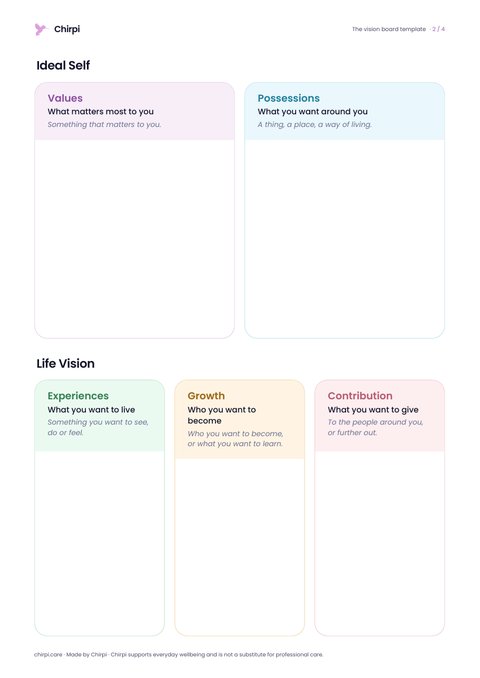
Divide your board into five panels and fill each one with whatever comes, a few words or a picture.
- Values: what matters most to you. A way of treating people, a kind of life.
- Possessions: what you want around you. A thing, a place, a way of living.
- Experiences: what you want to live. Something you want to see, do or feel.
- Growth: who you want to become, or what you want to learn.
- Contribution: what you want to give, to the people around you or further out.
Starting from areas rather than images keeps the board about your life and not about what happened to be in the magazine. It also stops one area, usually possessions, from taking over.
2. Treat every line as a seed
Nothing on the board is a promise yet. Write freely, including things you are not sure about. A board can hold far more than you will ever do, and that is fine. It is a picture of what you would like your life to hold, not a to-do list.
3. Write your why in one sentence
At the top, write one sentence for why any of this matters to you. Not a slogan: something you would say out loud. "Make things that help people feel calm." "Keep my family's days easy."
If the sentence does not come, our guide to finding your ikigai starts from the moments that already feel worth it, and the piece on how to find your purpose helps when nothing feels urgent.
4. Choose three to grow first
Time and attention are limited. Of everything on the board, pick three seeds you want to grow first, and write one line for why each one matters to you. Everything else stays on the board for later. Three is a choice, not a rule from a study: it is few enough that each one gets real attention.
5. For each one, name what's in the way
This is the step that turns a picture into a plan. For each of your three, write:
- The wish, in a few words.
- The best outcome, what it would feel like if it happened.
- The obstacle inside you, the honest one. Not "no time", but what usually happens instead: "I scroll after dinner", "I'm embarrassed to be a beginner".
- The plan: if that obstacle shows up, what will you do? "If I reach for my phone after dinner, I'll put it in the other room first."
6. Give each one small step this week, and a moment
For each priority, write one step small enough to do this week, and when it fits: morning, afternoon or evening. Small means small. Not "get fit": "Saturday morning, look up beginner swimming lessons nearby."
7. Look again in a month
Put a date in your calendar a month from now. On that day, read the board back and write four things: what you kept, what you let go, what changed, and one seed to add. Letting go of a seed is not failing. It makes room for the ones that matter.
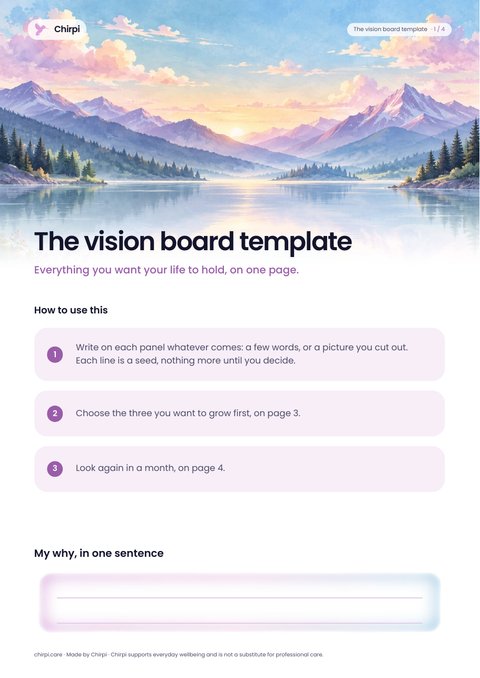
Put it on paper: the vision board template
- Your five panels, with a prompt in each
- Your three top priorities and a first small step
- A page to look again in a month
You'll get it right away. We'll also write once when the Chirpi app opens. No spam, leave anytime.
A worked example
Someone fills in their board. Under values: time with their kids. Under experiences: being near the sea more. Under growth: learning to swim properly, which they never did as a child.
Their sentence: "Be the parent who says yes to the sea."
They choose swimming as one of their three. The best outcome: swimming with their kids next summer without that tight feeling. The obstacle inside them: embarrassment at being an adult beginner. The plan: if they feel like skipping, they message the instructor before they can talk themselves out of it.
The step this week: Saturday morning, find a class for adult beginners. One small step, a time attached, and the obstacle named. That is the whole difference between this board and the one in the corner.
Paper or digital?
Either works. Paper is tactile, and putting it on a wall means you see it. A digital vision board lives on your phone, so it is with you when you actually have five minutes. What matters is not the format but the three steps most boards skip: the obstacle, the small step, and looking again.
Common mistakes
- Only pictures of things. Possessions are fine, but a board with nothing under values, growth or contribution often feels empty a month later.
- Someone else's board. If it would look the same on anyone's wall, it is probably not yours yet.
- Ten priorities. Choosing everything is choosing nothing. Three is plenty.
- Treating it as a contract. Seeds are allowed to change. Read it back and let some go.
- Never looking again. The month review is where a board starts to work.
When a vision board isn't what you need
A vision board is for ordinary weeks, when you have some room to think about where you are going. If everything has felt flat or heavy for weeks, if nothing has felt enjoyable in a long time, a board will not fix that, and it is not a failure of yours. Talk to your doctor, or to someone you trust. If you are in danger, our help page lists services that answer day and night.
Doing it with Chirpi
Making a board is easier than keeping one alive. The second part is where most of them stop.
Chirpi has this same board inside it: the five panels, your sentence at the top, and up to three top priorities. You can find your sentence in a short conversation with Chirpi or type it yourself, and nothing is kept until you keep it. Any line on your vision board can grow into a goal with a first step, and each goal becomes one small step that fits your morning, afternoon or evening.
Chirpi is coming to iPhone and Android. The first seven days are free, with no card.
Do vision boards actually work?
A board of pictures alone probably does not help much, and research on positive daydreaming suggests it can even lower the energy you put in. What helps is pairing the board with goals that are truly yours, an honest look at what is in the way, and one small step with a time attached.
What should I put on a vision board?
Start from five areas of your life rather than from images: what matters most to you, what you want around you, what you want to live, who you want to become, and what you want to give. A few words per area is enough; pictures are optional.
How many goals should a vision board have?
The board itself can hold as many seeds as you like. Choose three to work on first, so each one gets real attention, and keep the rest for later.
Where should I put my vision board?
Somewhere you will see it without trying, like a wall you pass every day or your phone's lock screen. Seeing it matters less than reading it back properly once a month.
How often should I update my vision board?
Look at it again about once a month. Write down what you kept, what you let go, what changed and one seed to add. Goals change as you do, and the board should too.
General wellbeing information, not medical advice. If you're struggling, here's where to find help.

Brice founded Chirpi after going through low times himself and watching his family go through them too. He learned that people mostly want to be heard, and to have somewhere to go. Chirpi is built on both.
Sources
- Oettingen, G. & Mayer, D. (2002). The motivating function of thinking about the future: Expectations versus fantasies. Journal of Personality and Social Psychology, 83(5), 1198-1212.
- Kappes, H. B. & Oettingen, G. (2011). Positive fantasies about idealized futures sap energy. Journal of Experimental Social Psychology, 47(4), 719-729.
- Sheldon, K. M. & Elliot, A. J. (1999). Goal striving, need satisfaction, and longitudinal well-being: The self-concordance model. Journal of Personality and Social Psychology, 76(3), 482-497.
- Wang, G., Wang, Y. & Gai, X. (2021). A meta-analysis of the effects of mental contrasting with implementation intentions on goal attainment. Frontiers in Psychology, 12, 565202.
- Gollwitzer, P. M. & Sheeran, P. (2006). Implementation intentions and goal achievement: A meta-analysis of effects and processes. Advances in Experimental Social Psychology, 38, 69-119.


