
What purpose means, and why "find" misleads
Most people asking how to find your purpose are not asking a philosophical question. They are asking a practical one: what should I be pointing at?
Purpose, in the way it is useful day to day, is a direction rather than a destination. It is the reason a Tuesday matters. Not the job title, not the five-year plan. The thing that makes you spend an afternoon one way instead of another.
It seems to matter more than it sounds. In a long-running study of adults in the United States, people who reported a stronger sense of purpose were more likely to still be alive fourteen years later, and that held whether they were young, middle-aged or retired. The researchers were careful, and so are we: this is an association, not proof that purpose adds years. But it is a strong hint that direction does something real.
Why "find" is the wrong verb
The word "find" suggests your purpose is already out there somewhere, finished, with your name on it. Look hard enough and you will spot it.
That belief makes things harder. In a set of studies published in 2018, people were nudged to think of interests either as fixed things you discover or as things you grow. When a new subject got difficult, interest dropped far more sharply among those who believed passions are found. If you think you are searching for the one right thing, every hard patch looks like proof you picked wrong.
The people who treated interest as something built kept going.
So the better question is not "what is my purpose?" It is "what am I willing to build?"
Start from evidence, not imagination
Imagination is a poor witness. Ask yourself what you care about in the abstract and you will produce something noble and vague.
Look backwards instead. Your last few months already hold the answer in rough form.
Three questions. Answer them about real weeks, not ideal ones.
- When did time move faster than usual? Not fun. Absorbed. The hour you looked up from and it was gone.
- What have you done for other people without being asked? We volunteer in the direction we care about long before we can explain it.
- What makes you irritated on someone else's behalf? Frustration points at a value. It is a value with nowhere to go.
Write the answers down plainly, because memory flatters. A journal is useful here for the same reason a receipt is: it remembers the week as it was, not as you would prefer it.
If the same two people and the same one problem keep appearing, you have a pattern, not a purpose. That is still progress.
A worked example. Someone answers: time moved fastest while rewriting a colleague's confusing handover notes; they keep offering to explain things nobody asked them to explain; and they get annoyed on behalf of new starters who are handed bad instructions. None of that is a calling. But the shape is obvious once it is written down, and it is nothing like the answer they would have invented if asked what they care about.
Say it small enough to act on
Big statements do nothing. "Make a difference" cannot be acted on this week.
Write one sentence. First person, under twelve words, with a verb in it.
- Make things that help people feel calm.
- Teach people the thing I had to learn the slow way.
- Keep my family's days easy.
Small and specific beats large and inspiring, because small can be tested. If your sentence would look at home on a poster, go narrower.
This is the same sentence Chirpi calls an ikigai. If the Japanese idea behind it interests you, the longer piece on how to find your ikigai covers the history, the three questions and a one-week practice.

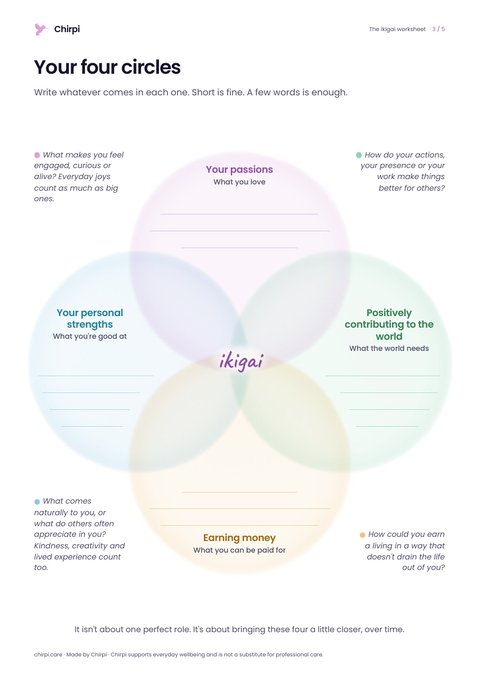
Do it on paper: the ikigai worksheet
- The three questions, with room to write
- Your four circles and a week of noticing
- A card for your sentence, to keep
You'll get it right away. We'll also write once when the Chirpi app opens. No spam, leave anytime.
Test it with one small step
A purpose you have only written down is a guess. A purpose you have acted on is information.
Pick the smallest action that points in the direction of your sentence, and do it this week. Not a plan. One step. Send the message. Spend twenty minutes on it. Ask the question.
Then notice what happened in your body rather than your head. Did it feel like effort you would repeat, or effort you dreaded?
That is the test. Run it for a few weeks and your sentence will start correcting itself, which is exactly what it should do. The person above might test theirs by rewriting one page of the handover doc nobody owns. If it is satisfying, the sentence is close. If it is dull, the pull was probably the teaching rather than the writing, and the sentence needs one word changed.
Turning a direction into something that fits inside one morning is its own skill, and small steps are where it gets practised.
What to do when nothing feels urgent
The hardest version of this is not a crisis. It is flatness. Nothing is wrong. Nothing is pulling, either.
Flatness is usually not a purpose problem. It is a sign that the week has become all maintenance: work, admin, recovery, repeat. Nothing in it asks anything of you that you chose.
Three things help more than thinking harder.
- Add one thing you picked. Small and voluntary beats big and sensible. The point is that it was your choice.
- Change the inputs. Direction rarely turns up in a room you have already searched. New people, new material, a different route home.
- Lower the bar for interesting. "Mildly curious" is enough to follow. Waiting to feel passionate is the fixed-interest trap again.
Purpose tends to show up behind movement, not ahead of it. Most people are waiting to feel certain before they act. It generally runs the other way round.
When purpose is not the question
Be honest with yourself about which problem you actually have.
If you cannot get out of bed, if nothing has been enjoyable for weeks, if you are tired in a way sleep does not fix, that is not a direction problem and no amount of writing will solve it. Talk to your doctor, or to someone you trust. If you are in danger, our help page lists helplines by country, checked against each service's own site.
This kind of work is for ordinary weeks. It is not a replacement for real help, and it goes much better once you have had some.
Finding yours in a conversation
Doing this alone is harder than it looks, because the honest answers arrive in pieces, on different days.
Chirpi is a companion that listens, remembers what matters to you, and helps you take one small step. You pick two or three starting points, Chirpi asks a few questions, and when there is enough to go on it offers one line in your own words Keep it, edit it, or write your own. Nothing is saved until you say so.
What makes it different from a worksheet is that it does not forget. Mention on Monday morning that an interview on Thursday is on your mind, and the practice you open at lunch starts there: "Is this about Thursday?" Your sentence then sits at the top of your vision board, above your priorities, and today's step is drawn from it.
Chirpi is coming to iPhone and Android. The first seven days are free, with no card.
Is purpose the same as a goal?
No. A goal is something you finish; a purpose is a direction you keep moving in. You can tick off every goal on a list and still feel aimless, because the goals were never pointing anywhere in particular. A useful purpose outlives the goals you set under it.
What if I do not feel like I have a purpose?
That is normal and it is not a character flaw. A sense of direction is usually assembled out of ordinary evidence rather than revealed, so the gap you are feeling is more often a lack of material than a lack of purpose. Look at what already absorbs you, then start there.
Does your purpose have to be your job?
No, and for most people it is not. Work is one place a direction can show up, but so are the people you look after, the things you make, and what you do with a free Saturday. Expecting a job to carry all of it puts more weight on work than most jobs can hold.
Can you have more than one purpose?
Yes. Most people carry two or three directions at once, and they rarely rank neatly. The question worth asking is not which one wins, but whether this week gave any of them room.
How long does it take to work out your purpose?
There is no set time, and treating it as a puzzle with a finish line tends to slow it down. A first sentence can take an afternoon. Testing it against real weeks and correcting it is the part that takes months, and that part never fully stops.
General wellbeing information, not medical advice. If you're struggling, here's where to find help.

Brice founded Chirpi after going through low times himself and watching his family go through them too. He learned that people mostly want to be heard, and to have somewhere to go. Chirpi is built on both.


